Why Your Ranking Report Is Lying to You (And What to Track Instead)
September 3, 2026 · PinPointMAPS
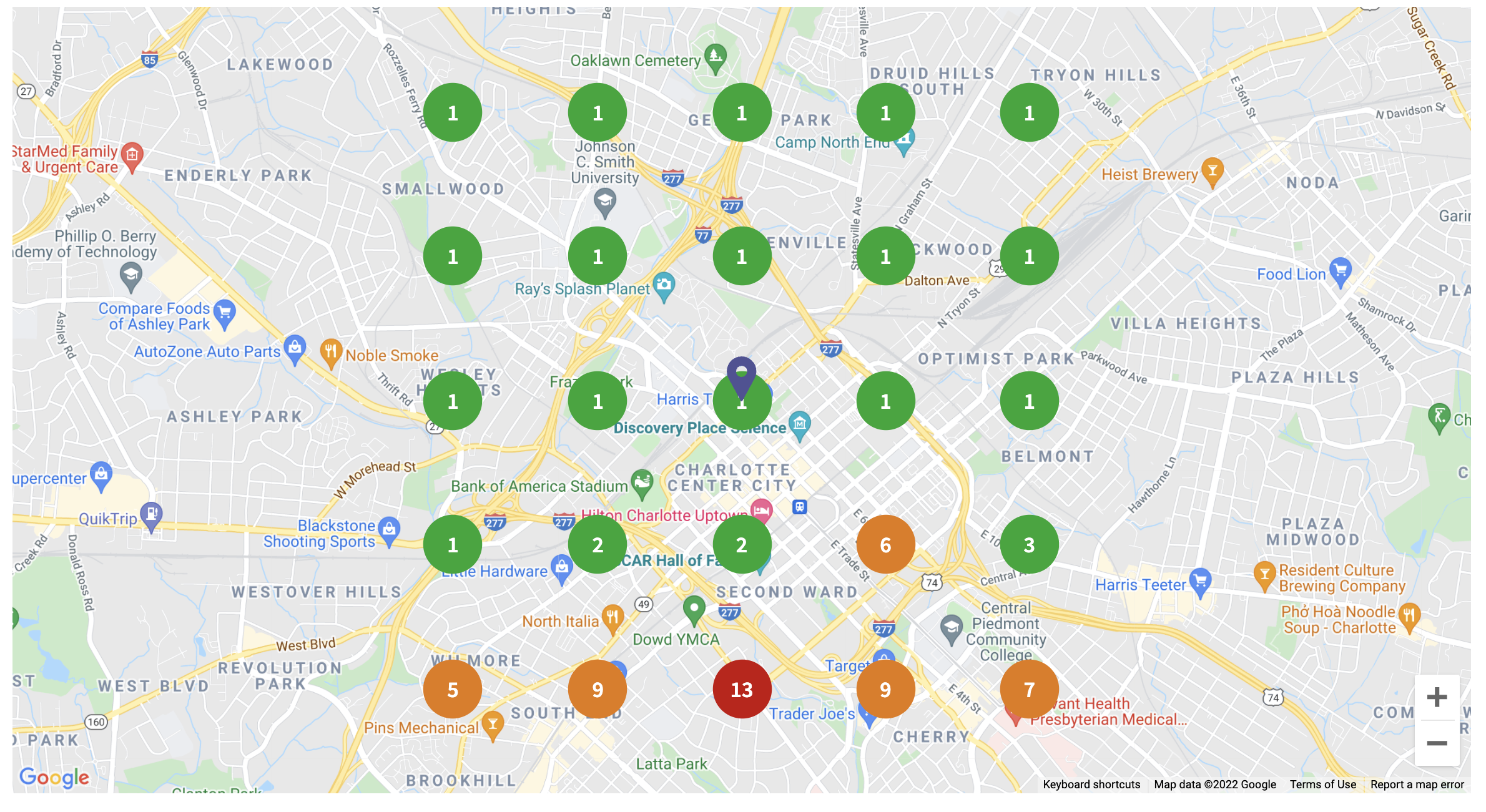
Every month, thousands of local businesses open a PDF that shows a grid of green, yellow, and red pins. Somewhere near the top it says something like "Average Rank: 3.2." The number went up from last month, so the report feels like good news.
Here is the problem. That number is not measuring anything a customer actually experienced.
Local map rankings are not a scoreboard. They are a snapshot of one simulated search, run from one coordinate, at one moment, with no search history attached. Change any one of those variables and the answer changes. Ranking reports sell certainty about a system that does not produce certain results.
There is no such thing as "your ranking"
Ask ten people standing in the same parking lot to search "coffee near me" and you will get ten different result sets. Not slightly different. Meaningfully different, with different businesses in the top three.
That happens because Google and Apple are not answering "who ranks highest for this phrase." They are answering "what is most useful to this specific person, right now, in this specific spot." A handful of inputs drive that:
Proximity. This is the heaviest factor in local results, and the one ranking reports quietly manipulate. A grid report pins a search origin at a fixed coordinate. Move that coordinate two blocks and the entire grid redraws. Businesses do not rank in a city. They rank in a radius that shifts with every user.
Search history and behavior. If someone has visited your website, tapped your listing, or gotten directions to you before, the platform weights you higher for them. Ranking tools search with a blank slate, so they never see the advantage you have already built with real customers.
Device and platform. Apple Maps, Google Maps, Google Search, and a voice assistant on a car dashboard all return different sets. Most ranking reports only look at one of them.
Intent and phrasing. "Coffee near me," "espresso downtown," and "coffee shop open now" pull different businesses. Tracked keywords are a guess at what people type. Real customers type thousands of variations.
Time of day. Open now filters, real-time busyness, and drive time all shift results between 8 a.m. and 8 p.m.
So when a report tells you that you moved from position 4 to position 2, the honest translation is: "In one simulated search, from one pin on a map, with no user context, a number changed." That is not a business result. It is a lab reading from a lab that does not resemble the street.
Why the reports keep getting sold anyway
Because they are easy to produce, easy to look at, and easy to spin.
A grid of colored pins looks like proof of work. It fills a monthly deliverable. And it is flexible in a way that benefits whoever is sending it. Shrink the grid radius and the map turns greener. Widen it and it turns red, which conveniently justifies a bigger retainer. Swap in easier keywords and the average improves. None of those adjustments require doing anything at all for the business.
The deeper issue is that ranking is a proxy metric, and a loose one. Even in the best case, a better ranking is only valuable if it produces more customers. So skip the proxy and measure the customers.
Track the data that actually moves
Google Business Profile and Apple Business Connect both report on what people did after they found you. These are not estimates or simulations. They are counts of real actions taken by real people. This is the layer that matters:
Direction requests. Someone tapped "Directions" to your address. That is a person putting your business into their navigation app and pointing a vehicle at your door. It is the closest thing to a foot traffic signal that exists in maps data, and it is the number we watch first.
Phone calls from the listing. Someone tapped the call button directly from your profile. Fully attributable, and in most service businesses, directly tied to revenue.
Website clicks. Someone moved from your listing to your site to learn more, check a menu, browse inventory, or book.
Bookings and reservations. Where the profile supports it, the appointment or reservation started right on the listing.
Discovery versus direct searches. Direct searches are people typing your business name. Discovery searches are people who did not know you existed and found you through a category or a need. Growth in discovery is the honest measure of new visibility. If a campaign is genuinely widening your reach, discovery searches climb.
Photo and profile engagement. Photo views, Q&A activity, and post interactions show whether people who land on your listing find enough there to keep going.
None of these depend on where a crawler pinned its search origin. They cannot be tuned by narrowing a grid. They are what happened.
What a real report looks like
A useful monthly report answers four questions in plain language:
How many people took an action that could turn into revenue? Directions, calls, clicks, bookings, added up and trended.
Did the mix change? Growth in discovery searches means new customers are finding you. Growth in direct searches means your brand is getting stronger. Both are good. They mean different things.
What did we do that caused it? Posts, offers, photos, Q&A, review responses, category and attribute changes, ad spend. Actions tied to the resulting movement.
What is next month's plan, and what number should it move?
For multi-location operators, add a fifth: how does each location perform against the others? The gap between your best and worst performing location is usually the largest and cheapest opportunity in the entire portfolio, and no ranking grid will ever show it to you.
The honest version
We do not promise rankings at PinPointMAPS, and we will not send you a grid of pins as proof that we did our job. We cannot control where a given person is standing, what they searched last week, or which phone they are holding. Nobody can, and anyone telling you otherwise is selling the map, not the market.
What we can do is work the profile continuously: publishing offers, posts, and events, keeping photos fresh, managing Q&A and reviews, keeping categories and attributes correct across Google and Apple, and running map ads at cost when it makes sense. Then we report what changed in direction requests, calls, website clicks, and discovery searches, and tell you exactly which actions we took to move them.
That is a harder report to produce. It is also the only one that tells you the truth.
Want to see what your profile data actually says? View a sample report at https://pinpointmaps.com/sample-report